Smoke in the Lanes (1987) by Dominic Reeve
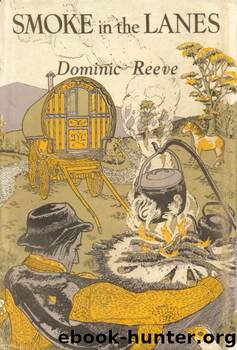
Author:Dominic Reeve
Format: epub
Published: 1987-07-30T16:00:00+00:00
2
I woke early the next morning and was up by half-past five. There seemed to be the promise of yet another hot day. I loosed Naylor and quelled his exuberance with a stern word; then I unchained the greyhound, rechaining her again after a few minutes. It was pleasant to see the horses dotted about the common, the flashy odd-coloureds showing up so strongly, while our black mare and Righteous’s chestnut were scarcely visible on the heath. Nelson’s little pony, its fur still caked with patches of congealed sweat from the previous evening’s trolley journey, had wound itself up so intricately in the plug-chain that it could hardly stand, so I hastily untied the chain and tied the pony by its rough rope halter to a gorse bush whilst I disentangled the chain from around its legs. Luckily no injury had been done, and I replaced the chain on the halter. Snorting loudly, the pony moved off within the circle of its restricted grazing patch.
It is astonishing how some horses will entangle themselves quite hopelessly in their tethering chains or ropes, whilst others will untangle themselves most expertly. An uncle of mine once had a small pony which, tethered by the neck, choked itself to death in a night of storm in its efforts to get free. Fortunately such major disasters are rare.
There were five horses grazing over the heath, and the rest appeared to be quite happy. I moved our mare to a fresh patch, hammered in the iron pin and left her. She was a pure-bred Welsh cob of the old sort, and her beauty of stance and line never failed to excite my admiration. We had had many bids for her, but she was not ‘for trade.’ It is usually only ‘spares’ or ‘rubbish’ that are. A good, quiet, honest wagon-pulling cob is hard to acquire today. The ideal ‘vanner,’ which may vary in size according to the type and weight of the wagon it is required to pull, must be dead-quiet in traffic, free from any vice, must allow itself to be tethered by a ‘plug-chain,’ and should preferably be a good doer on poor feed – few travellers give their horses any hay or corn or anything else apart from grazing, but with constant change of feeding grounds they rarely need it. A wagon horse must also learn to draw a heavy van out of a ‘stiff pull’ over muddy or soft ground, and must pull slowly and gently and steadily so as to avoid turning the wagon over as it lurches into ruts and dips. It must also be willing to do a lot of backing in order to get the wagon into narrow tree-grown places where it would be impossible to turn round to come out when leaving.
We usually, though by no means always, have a pony and trap besides the wagon and cob. The former is often ‘for trade,’ but the latter never – unless faulty! In the past I have sometimes had as many as five or six cobs in a year before finding a really good vanner.
Download
This site does not store any files on its server. We only index and link to content provided by other sites. Please contact the content providers to delete copyright contents if any and email us, we'll remove relevant links or contents immediately.
| Africa | Americas |
| Arctic & Antarctica | Asia |
| Australia & Oceania | Europe |
| Middle East | Russia |
| United States | World |
| Ancient Civilizations | Military |
| Historical Study & Educational Resources |
Room 212 by Kate Stewart(5119)
The Crown by Robert Lacey(4814)
Endurance: Shackleton's Incredible Voyage by Alfred Lansing(4780)
The Iron Duke by The Iron Duke(4354)
The Rape of Nanking by Iris Chang(4211)
Joan of Arc by Mary Gordon(4109)
Killing England by Bill O'Reilly(4001)
Say Nothing by Patrick Radden Keefe(3983)
I'll Give You the Sun by Jandy Nelson(3446)
Shadow of Night by Deborah Harkness(3367)
Hitler's Monsters by Eric Kurlander(3341)
Mary, Queen of Scots, and the Murder of Lord Darnley by Alison Weir(3210)
Blood and Sand by Alex Von Tunzelmann(3203)
Eleanor & Park by Rainbow Rowell(3171)
Darkest Hour by Anthony McCarten(3129)
Margaret Thatcher: The Autobiography by Thatcher Margaret(3081)
Book of Life by Deborah Harkness(2938)
Red Famine: Stalin's War on Ukraine by Anne Applebaum(2932)
The One Memory of Flora Banks by Emily Barr(2863)
